Topsoil Calculator Yards
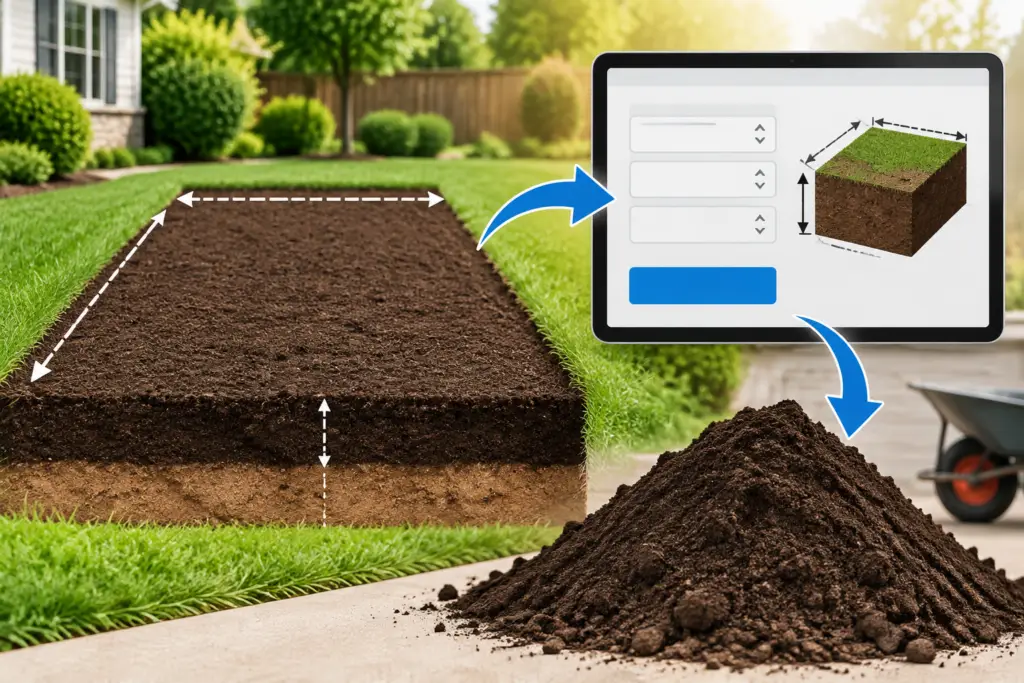
Our Topsoil Calculator helps you estimate the amount of material your project needs. Enter the length and width of the area, choose the depth, and the calculator converts the measurements into cubic yards.
Topsoil Calculator: Find Out How Much Topsoil You Need
Buying topsoil for a lawn, garden, flower bed, or low spot in the yard sounds simple until you have to figure out how many cubic yards to order.
A pile that looks enormous at the supplier may not go as far as you expect once it is spread a few inches deep. On the other hand, ordering too much leaves you with a pile of soil taking up space in the driveway.
For anyone doing the calculation by hand, the basic idea is just as simple:
Length × Width × Depth = Volume
The only tricky part is making sure all the measurements use the right units.
Topsoil Calculator Manual Calculations
Use the calculator to estimate the amount of topsoil required for your project.
You will generally need three measurements:
Length of the area
Width of the area
Depth of topsoil you want to add
Topsoil is commonly sold by the cubic yard in the United States, so the final result is usually expressed in cubic yards.
If your measurements are in feet and the depth is in inches, remember to convert the depth before calculating.
For example, 3 inches is:
3 ÷ 12 = 0.25 feet
So an area measuring 20 feet by 30 feet with 3 inches of topsoil would be:
20 × 30 × 0.25 = 150 cubic feet
Then convert cubic feet to cubic yards:
150 ÷ 27 = 5.56 cubic yards
You would need roughly 5.6 cubic yards based on the calculated volume.
How Does a Topsoil Calculator Work?
There isn’t a complicated formula hiding behind the calculator. It is simply calculating the volume of soil needed to fill a space.
Think about a flower bed that is 10 feet long and 5 feet wide. If you want to put 6 inches of soil on it, you’re not just covering the surface. You’re creating a layer of soil with a specific thickness.
That’s why soil is measured in cubic units.
A square foot describes an area. A cubic foot describes volume.
For topsoil sold in bulk, cubic yards are normally more useful.
The basic formula
When all measurements are in feet:
Length × Width × Depth ÷ 27 = Cubic Yards
The number 27 comes from the fact that one cubic yard contains 27 cubic feet:
3 × 3 × 3 = 27 cubic feet
If you’re working with inches for the depth, there’s also a convenient shortcut:
Length × Width × Depth in inches ÷ 324 = Cubic Yards
That can save you a conversion step.
How to Calculate How Much Topsoil You Need
Let’s walk through a typical backyard project.
Imagine you’re refreshing a lawn area that measures:
40 feet long
25 feet wide
3 inches deep
First, convert 3 inches to feet.
3 ÷ 12 = 0.25 feet
Now multiply the measurements:
40 × 25 × 0.25 = 250 cubic feet
Convert that to cubic yards:
250 ÷ 27 = 9.26 cubic yards
So the calculated requirement is approximately 9.3 cubic yards of topsoil.
That’s the number you would take to a supplier when you’re getting a quote.
Of course, don’t confuse the calculated volume with a guarantee that one particular truckload will cover the area perfectly. Real yards aren’t perfectly flat, and soil depth often varies.
Quick topsoil calculation table
| Area | 2 inches deep | 3 inches deep | 4 inches deep |
|---|---|---|---|
|
100 sq. ft. |
0.62 yd³ |
0.93 yd³ |
1.23 yd³ |
|
250 sq. ft. |
1.54 yd³ |
2.31 yd³ |
3.09 yd³ |
|
500 sq. ft. |
3.09 yd³ |
4.63 yd³ |
6.17 yd³ |
|
750 sq. ft. |
4.63 yd³ |
6.94 yd³ |
9.26 yd³ |
Topsoil Coverage Calculator: How Much Does One Yard Cover?
A cubic yard doesn’t have a fixed square-foot coverage number.
Depth changes everything.
One cubic yard contains 27 cubic feet of material.
If you spread it thinly, it covers a large area. Spread it several inches deep, and the coverage drops.
For example, one cubic yard spread over:
1 inch covers about 324 square feet
2 inches covers about 162 square feet
3 inches covers about 108 square feet
4 inches covers about 81 square feet
6 inches covers about 54 square feet
These numbers are based on mathematical volume and assume an even layer.
This is why asking “How many square feet does one yard of topsoil cover?” without specifying the depth doesn’t really have one answer.
Should You Buy Extra Topsoil?
This is where the calculator and the actual project can differ.
If the calculator says you need 5.56 cubic yards, you might wonder whether you should order exactly 5.56.
There are a few things worth checking first.
Is the ground level? If it isn’t, your soil depth won’t be uniform.
Are your measurements accurate? A few feet of difference across a large area can change the final volume considerably.
Will the soil settle? Soil can compact after it is spread and worked.
How is the supplier selling it? You may need to order by the quarter yard, half yard, full yard, or truckload depending on the supplier.
Rather than automatically adding a large percentage, look at the condition of your project and discuss the calculated quantity with the supplier when necessary.
Topsoil vs. Garden Soil vs. Compost
Don’t order material based on the word “soil” alone.
Topsoil, garden soil, and compost have different purposes.
Topsoil is commonly used for grading, filling, lawn preparation, and building up the upper layer of soil.
Garden soil is usually formulated for planting and may contain a blend of topsoil, organic matter, and other materials.
Compost is primarily an organic material used to improve soil and add organic matter.
A garden project may need one of these materials—or a combination.
The right choice depends on what you’re growing and what your existing soil is like.
Common Topsoil Calculation Mistakes
A calculator only works with the information you give it. These are some of the mistakes that can throw off the result.
Using inches as feet
If your area is measured in feet and your depth is 4 inches, you can’t simply enter “4” as the depth in a feet-based formula.
Four inches is 0.333 feet.
Forgetting cubic yards
A square-foot measurement tells you how much surface area you have. It doesn’t tell you how much soil you’ll need.
Soil volume requires three dimensions.
Measuring the wrong area
Don’t include patios, driveways, buildings, or other areas where soil won’t be placed.
Using one depth for everything
If you’re correcting several low spots, measure them individually when their depths vary significantly.
Ignoring slopes
A sloped yard can make a simple rectangular estimate less representative of the actual amount required.
For a significant grading project, more detailed measurements may be worthwhile.
When Should You Use a Topsoil Calculator?
An online topsoil calculator is useful whenever you’re planning to buy soil and want a reasonable volume estimate before placing the order.
It’s particularly handy for:
Lawn renovation
Garden beds
Flower beds
New landscaping
Filling low areas
Preparing planting areas
Raising soil levels
Small grading projects
You can calculate the quantity before calling a landscape supplier, which gives you a much better idea of what the project will cost.
It also makes it easier to compare prices. A supplier quoting $50 per cubic yard and another quoting $65 per cubic yard aren’t directly comparable unless you’re looking at the same quantity and material.
Frequently Asked Questions
How do I calculate how much topsoil I need?
Measure the length and width of the area and decide how deep you want the soil. Multiply length × width × depth, then divide the result by 27 if your measurements are in feet.
How many yards of topsoil do I need for 500 square feet?
At 2 inches deep, 500 square feet requires about 3.09 cubic yards. At 3 inches, it’s about 4.63 cubic yards, and at 4 inches, approximately 6.17 cubic yards.
How many cubic feet are in a cubic yard of topsoil?
One cubic yard contains 27 cubic feet.
How many inches are in a foot?
There are 12 inches in one foot. For example, 3 inches is 0.25 feet.
Can I use the calculator for an L-shaped yard?
Yes. Divide the L-shaped area into two or more rectangles, calculate each section separately, and add the results together.
Does one cubic yard of topsoil cover 100 square feet?
It depends on the depth. One cubic yard covers approximately 108 square feet at 3 inches deep, so it is close to 100 square feet at that depth.
Do I need to account for soil settling?
It can be worth considering, particularly for projects involving filling or grading. The amount of settling depends on the material, moisture, compaction, and how the soil is installed.