Mulch Calculator Yards
The amount of mulch needed can be estimated using a mulch calculator yards tool based on the area you wish to cover and the layer’s depth. You can compute the quantity in cubic yards, cubic feet, or bags rather than speculating on how many bags to purchase.
This is an estimate based on your measurements and selected depth. Actual coverage may vary with ground conditions and material settling.
A Mulch Calculator: What Is It?
A mulch calculator is a landscaping tool that calculates the amount of mulch required for a particular area. The calculator calculates the necessary volume once you specify the space’s size and the desired mulch depth.
The standard measure used by landscaping vendors in the US, cubic yards, is typically used to convey the outcome. Additionally, some calculators translate the outcome into cubic feet or an approximate quantity of mulch bags.
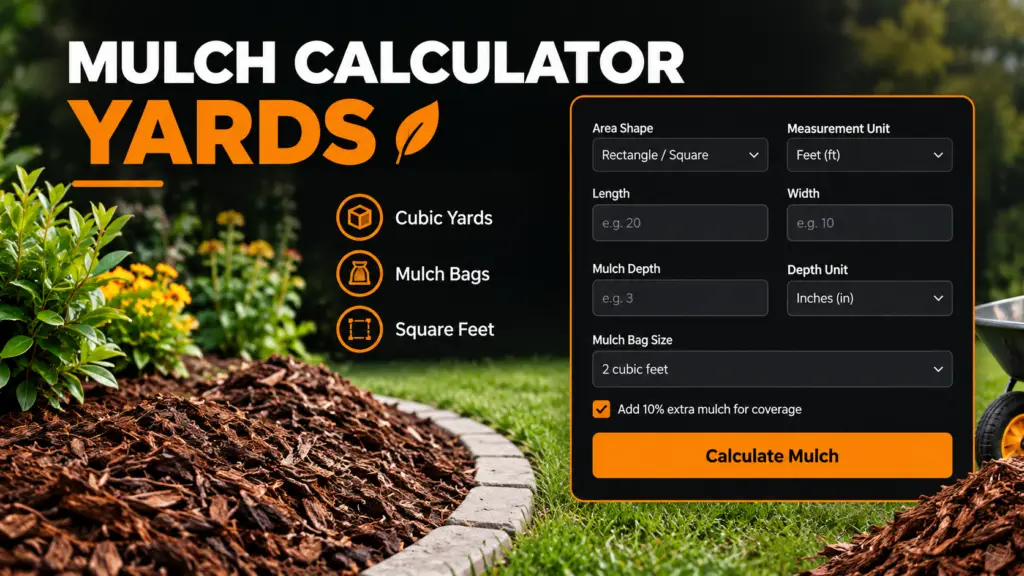
When planning multiple garden beds at once or purchasing mulch in bulk by the truckload, a mulch calculator cubic yards tool comes in very handy.
For instance, the area of a rectangle flower bed that is 20 feet long and 10 feet wide is 200 square feet. A 3-inch layer of mulch requires around 1.85 cubic yards.
You can use that estimate as a starting point to order the appropriate quantity without going over budget.
For converting values use cubic yard calculator.
How to Determine Mulch Yards
Two measurements determine how much mulch you need:
Area: The entire surface you wish to cover.
Depth: The thickness of the mulch layer.
You may compute the volume in cubic feet and translate it into cubic yards after you have these measurements.
The Formula for the Mulch Calculator
Use this calculation to find the area in feet:
Cubic Yards = Length * Width * Depth in Inches / 324
his formula works for rectangular or square areas when all dimensions are measured in feet and mulch depth is measured in inches.
The number 324 comes from converting cubic inches of depth across square feet into cubic yards. More simply, one cubic yard contains 27 cubic feet, and one foot contains 12 inches.
You can also calculate mulch using cubic feet:
Then convert the result into cubic yards:
Both methods produce the same result when the measurements are entered correctly.
Example: Mulch for a Rectangular Garden Bed
Suppose you have a garden bed that measures:
Length: 20 feet
Width: 10 feet
Mulch depth: 3 inches
First, multiply the length by the width to find the surface area.
20 × 10 = 200 square feet
Next, multiply the area by the depth in inches and divide by 324.
200 × 3 ÷ 324 = 1.85 cubic yards
You need approximately 1.85 cubic yards of mulch to cover this bed with a 3-inch layer.
If your supplier sells mulch in half-yard increments, check whether they can provide 2 cubic yards or offer another suitable quantity. Your final order should account for any additional coverage you need.
How to Utilize a Cubic Yards Mulch Calculator Tool
A mulch calculator is simple to use. Precise measurements matter more than complex calculations.
Step 1: Calculate the area
Measure each garden bed’s length and width in feet. Measure the diameter of circular beds. To make irregular spaces easier to calculate, divide them into smaller portions.
Step 2: Select the depth of the mulch
Enter the desired thickness in inches. Many landscape beds typically have a 2- to 3-inch layer, but the ideal depth varies depending on the material, plants, and soil conditions.
Step 3: Determine the volume
Enter your measurements into the calculator. Before placing an order, check the anticipated cubic yards. Convert the outcome into cubic feet or bags if necessary.
Step 4: Verify the quantity of the order
Take into account the supplier’s delivery increments, uneven ground, and bed edges. Only place orders for the extra materials you may reasonably anticipate using.
How much area does one cubic yard of mulch cover?
| Mulch depth | Approximate coverage |
|---|---|
|
1” |
324 SFT |
|
2” |
162 SFT |
|
3” |
108 SFT |
|
6” |
54 SFT |
Practical Ways to Estimate Mulch for Common Projects
The following examples show how a mulch calculator cubic yards tool can help with typical American landscaping projects.
| Project | Area | Depth | Approx. mulch |
|---|---|---|---|
|
Small flower bed |
100 sq. ft. |
2 inches |
0.62 yd³ |
|
Front garden bed |
200 sq. ft. |
3 inches |
1.85 yd³ |
|
Large landscape bed |
500 sq. ft. |
3 inches |
4.63 yd³ |
|
Tree ring |
50 sq. ft. |
3 inches |
0.46 yd³ |
These are volume estimates, not fixed purchase quantities. Measure the actual bed dimensions and use the depth appropriate for your project.
Example: Mulching Several Garden Beds
Suppose you need to cover three separate beds:
Bed A: 100 square feet
Bed B: 150 square feet
Bed C: 250 square feet
All three beds will receive a 3-inch layer.
The combined area is:
100 + 150 + 250 = 500 square feet
Calculate the volume:
500 × 3 ÷ 324 = 4.63 cubic yards
You need approximately 4.63 cubic yards of mulch before accounting for any extra material.
Combining the measurements can simplify ordering, but calculate each section separately if the beds require different depths.
Which Mulch Depth Is Ideal?
The type of mulch and the intended application site determine the proper depth.
For flower beds, a coating of two to three inches is usually appropriate.
Before adding more to established garden beds, measure the current layer.
Mulch should be applied uniformly around trees, avoiding the trunk and root flare.
In vegetable gardens, pay attention to the crop’s requirements as well as the mulch material.
When creating new garden beds, take into consideration the desired finished height as well as the current soil level.
Don’t cover plant crowns or pile mulch up against tree trunks. Overuse of mulch might hinder healthy growth by retaining too much moisture.
Relevent calculator:
Mulch Bags vs. Cubic Yards
Determine whether bagged mulch or bulk mulch is the preferable choice after determining the volume.
Mulch in bulk
Larger spaces, several beds, and landscaping projects requiring several cubic yards are typically feasible. Examine the supplier’s measurement technique, minimum orders, and delivery costs.
Mulch in bags
Ideal for projects requiring a controllable quantity, tiny garden beds, and restricted access regions. Before estimating the quantity needed, check the stated capacity of each bag.
FAQs
How deep should mulch be spread?
A 2- to 3-inch layer is commonly suitable for many landscape beds. The ideal depth depends on the mulch material, the plants, and the existing layer.
Avoid piling mulch against tree trunks or covering plant crowns. Check specific plant-care recommendations when necessary.
Is a mulch calculator accurate?
A mulch calculator provides an accurate mathematical estimate when you enter correct dimensions and depth. Actual coverage can differ because of uneven ground, material settling, and variations in installation.
Measure carefully and confirm the supplier’s delivery quantities before ordering.
How many bags of mulch equal one cubic yard?
One cubic yard equals 27 cubic feet.
18 bags of 1.5 cubic feet each equal 27 cubic feet.
13.5 bags of 2 cubic feet each equal 27 cubic feet, so you would need 14 whole bags to meet or exceed one cubic yard.
9 bags of 3 cubic feet each equal 27 cubic feet.
Check the volume printed on each bag because products vary.
Can I use a mulch calculator for circular flower beds?
Yes. Measure the diameter, divide by two to find the radius, and calculate the area using π × radius². Multiply the area by the depth in inches and divide by 324 to find cubic yards.
Should I remove old mulch before adding new mulch?
Not always. If the existing mulch layer is thin and in good condition, you may be able to add a small amount. If it has accumulated excessively, remove some before applying fresh material. Keep the final layer appropriate for the plants and away from tree trunks.
Is bulk mulch cheaper than bagged mulch?
Bulk mulch often offers better value for larger projects, but the total cost depends on delivery charges, minimum order quantities, and local prices. Bagged mulch can be more convenient for small beds or areas with limited access.